
Newsom’s Warning: Stay Ready, Stay United, and Defend Democracy
Overlooking the beauty of the Ashley River, a room filled to capacity gathered in Dorchester County to welcome California Governor Gavin Newsom on his “Take It Back” Tour. The setting was unmistakably Lowcountry, but the message was national and urgent: Democracy is protected county by county, neighbor by neighbor, and vote by vote.
The September 3rd Dorchester gathering was part of Newsom’s broader South Carolina organizing effort, tied to “Road to Flip the Future” and the message, “County by County: The Path to Power.” The aim was to bring people together, strengthen grassroots organizing, support Democratic candidates at every level, and build the local relationships needed to compete and win across South Carolina.
We understand the moment we are in.
This is a moment shaped by accumulated strain. The pressures did not arrive all at once: the Trump years as the 45th president; the COVID-19 pandemic; the national reckoning following George Floyd’s murder; and the continuing divisions left in their wake.
Now, in the first 19 months of Trump’s return to office as the 47th president, Americans have faced a new layer of instability. His tariff policies have added uncertainty for businesses and consumers, while international conflict has contributed to pressure on energy prices. At the same time, ethics experts and news reporting have raised continuing concerns about the overlap between the presidency and Trump family business interests.
For many people, these overlapping events have created a relentless buildup of worry, exhaustion, division, and uncertainty about what comes next.
But this is not a moment we have to face alone.
“It’s not about me. It’s not even about you. It’s about all of us,” Newsom said. He told the Dorchester audience that people had gathered not only for themselves, but also for one another, because they understood “what’s at stake in this moment.”
He spoke about the pressure people have carried and the basic human need to be recognized.
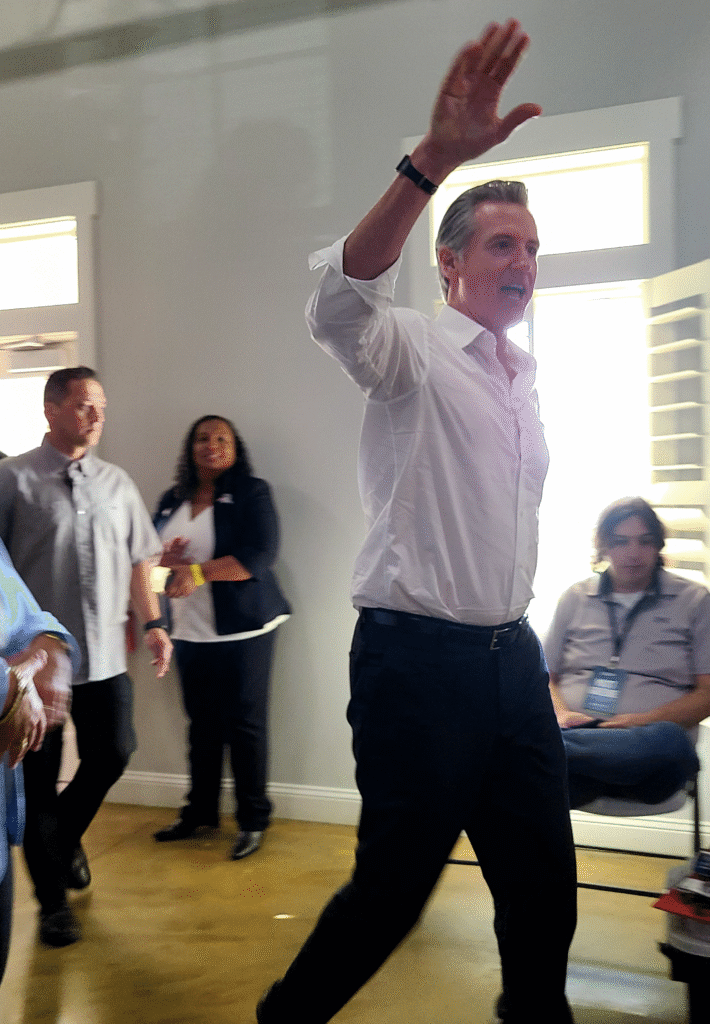
“We all need to be seen. We all need to be heard. And we also all need to be helped,” he said.
Near the beginning of the program, a young woman held a sign that read, “HOLD ME.” Gov. Newsom saw the sign, came over, and granted her wish with a hug. It was a small but memorable moment—one that reflected something larger than politics. In a time when many people are carrying worry, fatigue, uncertainty, and the feeling that they are not being heard, it expressed a simple human need for connection.
The Warning
Newsom warned the audience not to become numb to conduct that, he said, threatens democratic norms. He referred to Trump’s actions following the 2020 election, including Trump’s effort to obtain votes in Georgia, and urged people to remain alert when repeated claims and distractions are used to blur truth and weaken public trust.
“I don’t think there’s any other way to describe it: he is an invasive species,” Newsom said.
Newsom brought this warning to a personal level by recounting a late-night telephone call he said he received from Trump. He said he had expected to discuss activity in Los Angeles. Instead, according to Newsom, Trump began by insisting that he had won his debate against former Vice President Kamala Harris.
Newsom recalled Trump saying, “I won the debate against Kamala Harris.”
Newsom said he answered directly: “Well, respectfully, you did not win the debate against Kamala Harris.”
He told the audience that Trump then said the debate had been “a setup” and claimed it was “four against one.” When Newsom asked who the four people were, he said Trump counted Harris, the two interviewers, and the cameraman.
The story illustrated Newsom’s larger concern: repeated false claims and distractions can exhaust people, distort public understanding, and make people doubt what they can plainly see and know.
Newsom also pointed to California as a warning to the rest of the country. He discussed the federalization of 2,000 California National Guard personnel and the deployment of active-duty Marines to Los Angeles. California challenged the deployment in court, and the legal dispute continued through the appeals process.
He argued that actions like these should not be dismissed as distant California news, but watched carefully as possible models for political pressure elsewhere.
The purpose of the warning was not to create panic. It was to encourage preparation.
A Preview—and a Call to Hold the Line
Newsom told the Dorchester audience that what Americans are seeing now should be understood as “a preview” of what could come next. His warning was not meant to paralyze people. It was meant to encourage people to prepare, organize, and remain engaged.
He thanked the audience for its commitment, acknowledging that he arrived about an hour and a half behind schedule.
“You all showed up and stayed,” he said, despite the delay.
That mattered because, as Newsom reminded the group, races matter. The work is not limited to a presidential election or national politics. Local offices, county government, school boards, state legislative seats, judicial races, and congressional elections all shape the strength of democratic institutions.
Newsom urged Democrats to hold onto their momentum. He described this as a time when “it’s all on the line,” and he challenged the audience not to give in to fear, cynicism, anxiety, shock, or hopelessness.
His message to Dorchester Democrats was clear: stay connected, stay informed, keep organizing, and do not let the scale of the challenges ahead make us forget the power of local action.
The Work Ahead
Newsom’s speech carried both a warning and a source of hope: ordinary people still have power when they work together. Hope is not pretending threats are unreal; it is refusing to let fear, isolation, misinformation, or exhaustion decide what happens next.
Democracy is defended locally—in county election offices, polling places, school-board meetings, town halls, neighborhoods, and the everyday conversations in which neighbors help one another separate fact from fiction. That is why Dorchester County, local organizing, and every local race matter.
The Action
Dorchester Democrats can meet this moment through steady, peaceful, lawful civic action:
- Prepare to vote. Go to the Election 2026 section of the Dorchester County Democratic Party’s website and follow the instructions there to check your voter registration, find your polling place, view the candidates, and create your voting plan.
- Share verified information. Use the DCDP Election 2026 page, SC Votes, county election offices, and credible local reporting—not unverified social-media posts—for voting deadlines, polling locations, ballots, early voting, absentee voting, and election results.
- Correct misinformation calmly. Before sharing a claim, find the original credible source. Do not spread false voting information merely to criticize it.
- Support election workers. Poll workers, county election staff, and volunteers are our neighbors. Treat them with respect, and speak up against harassment or false claims about their work.
- Help someone participate. Encourage a friend, family member, coworker, or neighbor to check their registration and make a voting plan.
- Show up locally. Attend Dorchester Democrats meetings and volunteer for voter education, neighborhood outreach, phone banks, canvassing, events, communications, or candidate support.
- Pay attention to local races. County government, school boards, municipal offices, state legislative seats, and judicial races shape daily life and democratic accountability.
- Document concerns safely. If you witness possible voter intimidation or misleading election information, note the date, time, location, and details. Avoid confrontation, and report concerns through appropriate election channels.
We prepare by checking facts before we share them, helping neighbors participate, supporting election workers and local institutions, and showing up again and again.
As Newsom reminded the Dorchester audience:
“You all showed up and stayed.”
“Races matter.”
“It’s all on the line.”
And he began with the truth that brings the message together:
“It’s not about me. It’s not even about you. It’s about all of us. … You understand what’s at stake in this moment. You understand how precious this moment is.”
Yes, we understand the moment we are in.